
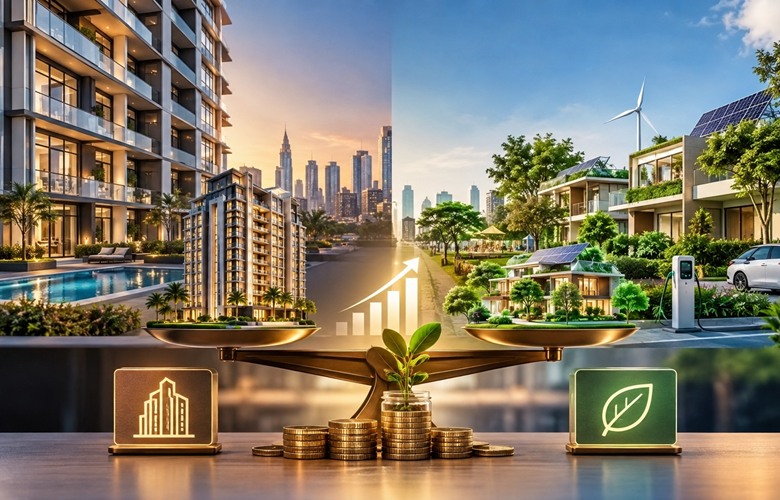
Luxury Apartments Vs Sustainable Communities is no longer an either-or choice in 2026. A sustainable community with luxury-grade specifications can offer a 10–15% higher resale premium, 20–50% lower operating costs, and faster resale potential, making the overlap of luxury and sustainability a smarter investment strategy.
Key Takeaways at a Glance
- IGBC and LEED-certified residential projects command a 10-15% higher sale price and 10-20% higher rental income than uncertified peers (Source: CII-IGBC 2023, JLL India).
- Dwarka Expressway flat prices rose 75% in 3 years and 152% in 5 years (Source: 99acres property rate index).
- Green construction adds only 2-5% to build cost but recovers this in 3-5 years through 20-50% energy savings and 30-50% water savings.
- 63% of 2026 residential sales in top Indian cities now sit in the ₹1 Cr+ premium bracket, up from 53% in 2024 (Source: Knight Frank / Reuters, early 2026).
- Anarock projects a further 20-40% appreciation on Dwarka Expressway over 2026-2028; Knight Frank calls the corridor “directional data.”
- Sobha Altus in Sector 106 is one Dwarka Expressway address that carries both an ultra-luxury builds and an IGBC Green Homes Gold Star pre-certification.
Why “Luxury vs Sustainable” Is the Wrong Question in 2026
Until about 3 years ago, this was a real trade-off. You chose the marble lobby and imported taps, or you chose the solar panels and rainwater harvesting. Rarely both.
That gap has closed.
In 2026, the top-selling residential launches across Delhi-NCR share 2 traits: ultra-luxury specifications and a green-building certification (IGBC, LEED, or GRIHA). The old binary, luxury apartments vs sustainable communities no longer maps to what serious buyers actually shortlist. It maps to what 2020-era marketing copy pretended was still a choice.
The data explains why the merger happened. Certified projects sell for 10-15% more than uncertified counterparts (CII-IGBC, 2023). They rent for 10-20% more (JLL India). They sell up to 20% faster. And the construction cost gap has fallen to just 2-5% at the build stage a premium that clears in 3-5 years of ownership through utility savings.
The buyer who still chooses between luxury and sustainability is choosing between 2 returns when they could stack both.
The Luxury Investment Case: What Actually Drives Returns
Luxury residential real estate in India has 3 defensible investment metrics. Set aside the marketing language and look at the numbers.
1. Segment share is growing.
Homes priced above ₹1 Cr now account for 63% of total residential sales in top cities in 2026, up from 53% in 2024 (Reuters / Knight Frank). In Delhi-NCR alone, luxury launches capture up to 80% of new supply. This is no longer a niche premium play.
2. Rental yields are lower, but capital appreciation is steadier.
Luxury units on Dwarka Expressway currently deliver about 2% rental yield, but capital appreciation across the corridor has outpaced most other Gurugram sub-markets a 75% rise in the last 3 years per 99acres. Knight Frank India AVP Neha Bajaj publicly notes that Gurgaon’s next significant price movement will originate from Dwarka Expressway sectors, calling it directional data, not speculation.
3. Buyer profile is stable.
HNIs, NRIs, and senior professionals treat luxury addresses as inflation hedges and inheritance assets. Between 2010 and 2024, 41,899 of the 42,816 units launched on Dwarka Expressway were absorbed, an unusually strong absorption rate that signals genuine demand, not speculative froth.
What the standalone luxury apartment case does NOT deliver on its own: operating cost efficiency, ESG alignment, and the certification premium at resale.
The Sustainable Community Case: What the Data Actually Says
Over the last 5 years, “sustainable community” quietly shifted from a Bangalore villa concept to a mainstream investment thesis. The Indian green building sector is projected to reach $39 billion, with over 7,000 IGBC-certified projects spanning 1,370 million sq.ft. across the country.
The investor case for green luxury real estate rests on 4 numbers that appear consistently across CII-IGBC, JLL India, Housivity, and Puravankara advisory data:
- 10-15% higher sale price versus comparable uncertified projects
- 10-20% higher rental income
- 20-50% lower energy consumption
- 30-50% lower water consumption
Add government policy tailwinds, India’s 2070 net-zero target, additional FAR incentives in several states for IGBC-rated projects (Assam offers 3% for Silver, 6% for Gold, 9% for Platinum), and Gurugram’s 15-30% circle rate revision in 2026, and the operating economics tilt further toward certified assets.
What the pure sustainability case does NOT deliver on its own: the “prestige address” pull that drives ultra-luxury demand, and the concierge-grade lifestyle HNI buyers price into their shortlist.
Where the Two Categories Merge: IGBC-Certified Luxury on Dwarka Expressway
Dwarka Expressway between Sectors 102-113 is the clearest live example of the merged category. Prices doubled between 2022 and 2026 (True Asset Consultancy market data). Premium launches now sit between ₹12,000 and ₹20,000 per sq.ft. on the corridor (Ganga Realty market report). Sectors 104 and 106 anchor the ultra-luxury end.
Sobha Altus in Sector 106 Gurgaon is one address on this corridor that sits precisely in the overlap. The project’s IGBC Green Homes Gold Star pre-certification, biophilic design with a 5 ft peripheral vegetation belt, rainwater harvesting, and energy-efficient planning satisfy the sustainable community filter. Its 46,080 sq.ft. Waverly Club, 3 towers with up to 28 floors, ultra-luxury 3 BHK and 4 BHK residences ranging 3,045 to 3,853 sq.ft. and a starting price around ₹7.76 Cr satisfy the luxury filter.
The project is RERA-registered under RC/HARERA/GGM/828/560/2024/55 with December 2028 possession. That combination of ultra-luxury specifications, IGBC Gold Star pre-certification, HARERA registration, and Dwarka Expressway address is not incidental. It is what the 2026 buyer now expects to see before shortlistin.
Comparison Table: 5 Metrics That Matter to an Investor
| Metric | Standalone Luxury Apartment | Sustainable Community | Certified Luxury (Merged) |
|---|---|---|---|
| Resale premium (5-year) | Baseline | +10-15% vs baseline | +10-15% plus luxury brand pull |
| Rental yield | 2% (Dwarka Expressway Avg) | 10-20% higher rent than baseline | Higher absolute rent + certified premium |
| Operating cost | Standard | 20-50% lower energy; 30-50% lower water | Same low operating cost |
| Buyer pool (resale) | HNI + upgrader | ESG buyer + NRI + institutional | Full spectrum — largest resale audience |
| Capital appreciation (Dwarka Expressway) | 75% in 3 years | Add 10-15% certification premium | Full 75% plus certification premium |
Sources: CII-IGBC (2023), JLL India, 99acres property rate index, Knight Frank India, Anarock market reports.
Verdict: Who Should Pick What in 2026
The old advice was: luxury for lifestyle, sustainable for values. That does not survive contact with 2026 data.
- HNI end-users, pick certified luxury. The lifestyle you want and the certification premium you did not know you were leaving on the table both sit in the same asset. Sectors 104, 106, and parts of Sector 84 on Dwarka Expressway are the current fit.
- NRI investors from Dubai, Singapore, London, and the US, pick certified luxury for a second reason: ESG-aligned assets are more liquid at exit, and NRI buyer pools now filter listings by green rating before shortlisting.
- Pure resale investors, pick certified units in a merged-category project. Yield and appreciation both benefit; days on market at resale drop by up to 20%.
- Wellness-first family buyers pick a project with genuine biophilic design plus IGBC Gold Star or higher. Peripheral vegetation, temperature-controlled indoor pool, and Zen gardens are functional here, not decorative.
Every category above points to the same conclusion. In 2026, the luxury apartments vs sustainable communities framing is a shortcut that costs money.
What We Are Seeing on the Ground in Sector 106
Our advisory desk has walked buyers through the Dwarka Expressway corridor for over a decade. In the last 18 months, we have seen a consistent pattern: buyers arrive with “luxury or sustainable” on their shortlist and leave asking only for green-certified luxury.
A Dubai-based NRI buyer we worked with in Q2 2025 shortlisted 3 Sector 106 towers before booking a 4 BHK at Sobha Altus in the ₹7.76 Cr band. His decisive filter wasn’t clubhouse size or developer brand; those, he told us, were table stakes. It was the IGBC Green Homes Gold Star pre-certification and the biophilic 5 ft peripheral vegetation. He treated the certification as a resale insurance policy for 2030-2032.
We are also seeing local Gurugram upgraders, typically moving from Sectors 47-56 to Dwarka Expressway, ask about green certification on the second site visit, not the first. That is a market maturing.
“The luxury market and the sustainable market are not rivals in 2026. They are the same buyer with two spreadsheets. The projects that satisfy both are the ones we are seeing sell first.”
Investors who still treat the comparison as either-or are underwriting a 10-15% resale gap they do not have to accept.
The Bottom Line for a 2026 Buyer
The luxury apartments vs sustainable communities debate is a legacy of a market that has already moved on. In 2026 Dwarka Expressway conditions, the certified luxury tower stacks both returns on the same asset:
- Certification adds a 10-15% resale premium and 10-20% rental premium, numbers that hold across CII-IGBC and JLL India data.
- Operating cost savings of 20-50% on energy and 30-50% on water recover the small construction premium within 3-5 years.
- Corridor tailwinds, 75% 3-year appreciation, 20-40% projected for 2026-2028, upward circle rate revisions, apply to certified and uncertified alike, but the certified asset captures the larger buyer pool at resale.
For buyers evaluating the Dwarka Expressway corridor, particularly Sector 106, the practical next step is a site visit to a project that carries both filters. Sobha Altus Gurgaon, with its IGBC Green Homes Gold Star pre-certification and ultra-luxury 3 BHK and 4 BHK residences, is one such address. Our advisory desk is available for floor plan requests and a walkthrough of the merged-category thesis on any live inventory.
Read more: https://www.sobhaaltusgurgaon.info/blog
Frequently Asked Questions
Is a sustainable community a better investment than a luxury apartment in 2026?
Yes, when you compare uncertified luxury to certified sustainable community stock. Certified projects deliver a 10-15% resale premium, 10-20% higher rent, and 20-50% lower energy costs per CII-IGBC and JLL India. The best 2026 choice isn’t in isolation; it is a project with both ultra-luxury specifications and IGBC Gold Star certification.
How much extra do IGBC or LEED-certified apartments sell for in India?
IGBC and LEED-certified residential projects command a 10-15% higher sale price than uncertified peers, per CII-IGBC 2023 data cited across major industry reports. Rental premiums run 10-20% higher. Resale liquidity improves because institutional investors, NRIs, and ESG-focused funds now filter listings by certification before shortlisting. Days on market at resale drop by up to 20%.
Is Dwarka Expressway a good corridor for sustainable luxury investment right now?
Yes. Dwarka Expressway flat prices rose about 75% in the last 3 years and 152% over 5 years, per 99acres, with premium sectors like 104, 106, and 113 clustering luxury launches. Anarock projects a further 20-40% appreciation over 2026-2028. Combining that corridor growth with IGBC certification amplifies both capital appreciation and rental yield.
What is the price premium for a luxury apartment with green building certification?
Green-certified luxury apartments carry a 7-15% resale premium and 10-20% rental premium over comparable uncertified towers, per JLL India and CII-IGBC studies. Upfront construction costs are only 2-5% higher, and green features typically pay for themselves in 3-5 years through 20-50% energy savings and 30-50% water savings. Net investor return improves substantially.
Are sustainable communities significantly more expensive to buy than luxury apartments?
Not significantly. IGBC-compliant construction adds only a 2-5% cost premium at the build stage per industry estimates, translating into a 3-8% higher shelf price for buyers in most cases. Given the 10-15% resale premium, 20-50% lower utility bills, and higher rental demand, the initial gap is recovered within 3-5 years of ownership.
Which project on Dwarka Expressway offers both luxury and sustainability?
Sobha Altus in Sector 106 is one Dwarka Expressway address that carries an IGBC Green Homes Gold Star pre-certification, along with a 46,080 sq.ft. Waverly Club, biophilic design with a 5 ft peripheral vegetation belt, and ultra-luxury 3 BHK and 4 BHK residences. Prices start around ₹7.76 Cr. RERA: RC/HARERA/GGM/828/560/2024/55.
How do NRIs typically evaluate sustainable luxury apartments in Gurugram?
NRIs living in Dubai, Singapore, London, and the US often filter Gurugram listings by green certification first because they see ESG-aligned assets as more liquid at exit. They prioritize HARERA registration, IGBC or LEED status, and developer track record. Corridors like Dwarka Expressway with new-era luxury towers meeting both filters draw the strongest NRI inquiry volume.
What are the risks of buying an uncertified luxury apartment in 2026?
Uncertified luxury towers face 3 rising risks. First, resale value trails certified peers by 10-15% within 5-7 years. Second, energy and water bills stay 20-50% higher for the life of the asset. Third, institutional and NRI buyer pools now screen out uncertified stock, shrinking the resale audience and lengthening days on market at exit.
Should I choose a smaller certified luxury apartment or a larger uncertified one?
Choose the certified unit even if it is slightly smaller. Certification adds 10-15% to resale value and 10-20% to rental income for the life of the asset. Uncertified extra square footage doesn’t compound the same way and increases operating costs. In 2026 Dwarka Expressway conditions, certification outweighs raw carpet-area gains for most investors.
Is 2026 a good year to enter Dwarka Expressway luxury or sustainable community assets?
The corridor has already delivered 75% appreciation over 3 years and 152% over 5 years, per 99acres. The Haryana Government revised circle rates upward 15-30% in 2026, signalling institutional confidence. With the Blue Line metro extension confirmed for 2026-27 and Global City coming online, entry now still captures the projected 20-40% appreciation window through 2028-2030.
Sobha Altus, Sector 106, Dwarka Expressway, Gurgaon
Ask for the current price list, available floor plates and payment plan.